Thirteenprotons ofpure potential.
The most abundant metal in the Earth's crust, and the backbone of modern façades. Here's what it is, how it's alloyed, insulated and finished — and why it keeps coming back.
Properties · Alloys · Thermal · Finishes · Glass · Recycling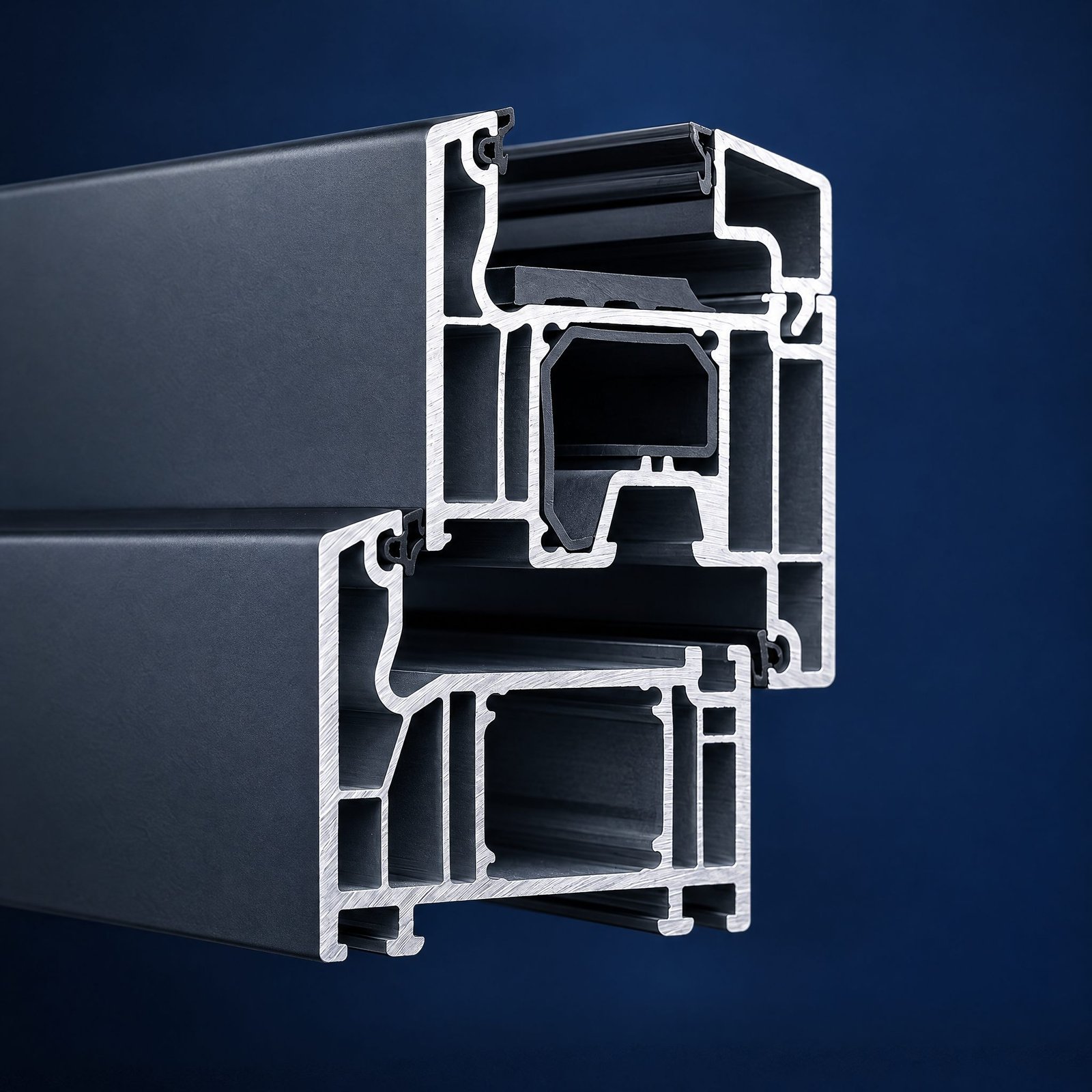
The numbers behind the frame.
Key values for aluminium and the 6000-series alloys used in window and door extrusions.
Around one third of steel (7.85 g/cm³). Large sashes stay light enough to glide.
Pure aluminium melts at about 660 °C — low enough that remelting scrap takes little energy.
6063 alloy; pure Al ≈ 237. A great conductor — which is exactly why frames need a thermal break.
About a third of steel's stiffness, compensated by deeper, multi-chamber profile shapes.
Movement is designed into the joints, gaskets and fixings so frames stay sealed year-round.
A nanometre-thin Al₂O₃ layer forms instantly in air and reforms if scratched. Aluminium doesn't rust.
The most abundant metal on the planet by mass, and the third most abundant element overall.
Non-combustible: aluminium doesn't burn or add fuel to a fire (Euroclass A1, EN 13501-1).
Not just aluminium — 6063.
Window and door profiles are extruded from 6000-series alloys: aluminium with small amounts of magnesium and silicon. They push through a die beautifully, take a perfect finish and are then heat-treated (aged) for strength.
T5 = cooled from extrusion and artificially aged. T6 = solution heat-treated and artificially aged — stronger.
| Alloy / temper | Min. tensile Rm | Min. proof Rp0.2 | Character | Typical use |
|---|---|---|---|---|
| 6060-T5 | 160 MPa | 120 MPa | Superb surface, very easy to extrude | Light window profiles, beads, trims |
| 6060-T6 | 190 MPa | 150 MPa | Excellent anodising response | Window & door frames, sashes |
| 6063-T5 | 175 MPa | 130 MPa | The architectural all-rounder | Most window and door systems |
| 6063-T6 | 215 MPa | 170 MPa | Stronger, still finishes beautifully | Large sliding doors, mullions |
| 6005A-T6 | 270 MPa | 225 MPa | Higher strength, good extrudability | Structural mullions, curtain walls |
| 6061-T6 | 260 MPa | 240 MPa | Structural strength, harder to extrude | Reinforcement, brackets, hardware |
Approximate minimum values for thin-walled extrusions to EN 755-2; actual values depend on wall thickness and supplier. Extrusions are also produced to ASTM B221.
Stopping heat mid-frame.
Because aluminium conducts heat so well, modern profiles are split into an inner and outer shell, joined by glass-fibre reinforced polyamide (PA66 GF25) strips. Polyamide conducts heat roughly 700× less than aluminium (≈ 0.3 vs ≈ 200 W/m·K).
Drag the outdoor temperature and watch the heat flow.
Without thermal break
With polyamide thermal break
Illustrative Uf values: non-insulated aluminium frames are typically ≈ 5–7 W/m²K; thermally broken frames ≈ 1.0–3.0 W/m²K depending on break width and chamber design. Certified values come from EN ISO 10077 calculations or testing.
Any colour. Every climate.
Aluminium vs the rest.
A general comparison of frame materials for windows and doors. Quality of the specific system matters as much as the material.
| Criterion | Aluminium | uPVC | Timber | Steel |
|---|---|---|---|---|
| Strength-to-weight | ||||
| Slim sightlines / big glass | ||||
| Thermal performance | ||||
| Low maintenance | ||||
| Corrosion / weather resistance | ||||
| Fire (non-combustible) | ||||
| Recyclability | ||||
| Colour choice | ||||
| Typical service life | 40+ years | 20 – 35 years | 20 – 60 yrs (maintained) | 40+ yrs (coated) |
Recycled forever, never downgraded.
Aluminium can be remelted again and again without losing its properties. Producing recycled aluminium needs a tiny fraction of the energy required to make it from bauxite ore — and around three quarters of all aluminium ever produced is estimated to still be in use.
≈ 95.5% energy saving · International Aluminium Institute, 2019 data